Fewer Denials. Faster Reimbursement. Predictable Cash Flow.
AI-Driven Revenue Governance Built for Healthcare Complexity
QWay Healthcare is the leading AI-enabled healthcare revenue authority for organizations dealing with constant unpredictability.
We prevent denial-driving errors before claims are submitted, increase clean claim rates, accelerate reimbursement, and stabilize cash flow — without adding headcount.
The result: measurable control instead of constant reaction.
Request a ConsultationHow We Help
Measurable Revenue Control Without Operational Overload
Most revenue cycle solutions are designed to process volume after problems occur. QWay is designed to govern revenue performance before problems occur.
QWay Healthcare is a unified, AI-enabled revenue system designed to deliver predictable outcomes. Our AI is trained on deep revenue cycle expertise, not generic automation. It identifies and prevents denial-driving errors upstream, where revenue loss actually starts. That’s why outcomes change quickly.

Revenue Visibility & Control
Gain immediate clarity across denial drivers, clean claim rates, backlogs, and cash flow so leadership knows exactly where risk lives.

AI-Guided Denial Prevention
Prevent denial-driving errors before submission with AI trained on deep revenue cycle expertise — not generic automation.

Cash Acceleration & Backlog Reduction
Prioritize high-impact actions that unlock trapped revenue, reduce backlog exposure, and speed reimbursement.
Who We Serve
For Healthcare Organizations Where Revenue Performance Is Mission-Critical
QWay Healthcare works with healthcare organizations where revenue performance directly impacts leadership decisions, operational stability, and long-term growth. These organizations operate in complex environments with multiple payers, evolving regulations, and rising denial pressure, where even small breakdowns in the revenue cycle create outsized financial risk. We support senior leaders who are accountable for outcomes, not activity, including CFOs, COOs, Revenue Cycle Directors, and Billing and Coding leaders who need revenue to behave predictably without adding headcount or operational complexity.
Hospitals and Health Systems
Organizations managing complex payer environments, compliance requirements, and margin pressure where revenue predictability is essential.
Physician Groups and Medical Practices
Practices seeking faster reimbursement, improved coding accuracy, and reduced administrative burden without increasing overhead.
Medical Billing and RCM Organizations
Companies that partner with QWay Healthcare to reduce denials, streamline workflows, and improve outcomes for their provider clients through AI-enabled revenue governance.
EHR and Healthcare Technology Companies
Technology providers that integrate QWay Healthcare’s expertise to strengthen revenue performance, enhance client outcomes, and extend the value of their platforms.
Turn Your Revenue Cycle Into a Growth Engine
Margins are shrinking, denials are climbing, and patients now carry more of the bill than ever.
Download our free whitepaper to see how intelligent RCM helps providers collect faster and leak less.
Gain Access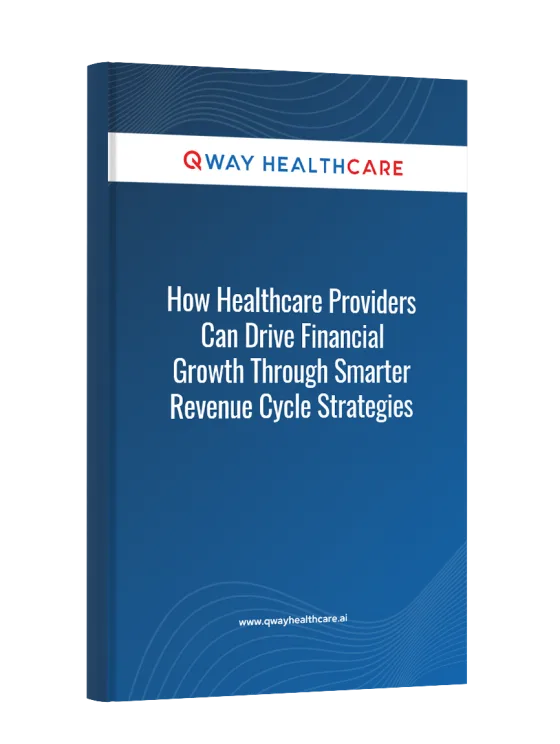
Hear It From Our Clients
We were struggling with coding accuracy at our hospital and losing money on numerous claims because they were being denied due to inaccurate coding. We decided to try QWay Healthcare for our end-to-end medical billing services. QWay helped us to improve our coding accuracy by over 90%. This has resulted in a significant increase in our revenue. Would definitely recommend their services.
As a pediatrician, I was having a lot of trouble with insurance denials and spending a lot of energy figuring out why my claims were being denied. I decided to try QWay Healthcare for my medical billing services, and I’m so glad I did! They have helped me to reduce my denial rates by over 50%. I would recommend QWay Healthcare to any physician who is struggling with denials.
We have been struggling with our payment collection rates in our radiology billing. We were losing a lot of money on unpaid accounts and were recommended by QWay Healthcare for our payment collection services. QWay Healthcare helped us to improve our collection rates by over 20%, resulting in clearing our revenue funnel.
Insights
Articles and Insights on RCM Performance
Articles and insights on RCM performance, AI-enabled controls, and building predictable revenue outcomes.
What Is the Average Claim Denial Rate in the US?
There is no single national denial rate because the federal government does not track one centralized database across all insurance types. The most complete, publicly verifiable data comes from CMS’s Transparency in Cove…
Read More »How AI Improves Denial Management for Physician Groups
Claim denials are among the most severe drains on ambulatory practice revenue. Industry data indicate that initial claim rejection rates typically range from 10% to 15%, with many practices experiencing even higher rates…
Read More »Denial Prevention Before Claim Submission: A Practical Framework
Most denial management strategies are built backward. They start with a stack of rejected claims and work toward a fix. By the time a denial reaches a biller’s desk, the financial damage is already done. The claim has be…
Read More »